Spain - Tarragona
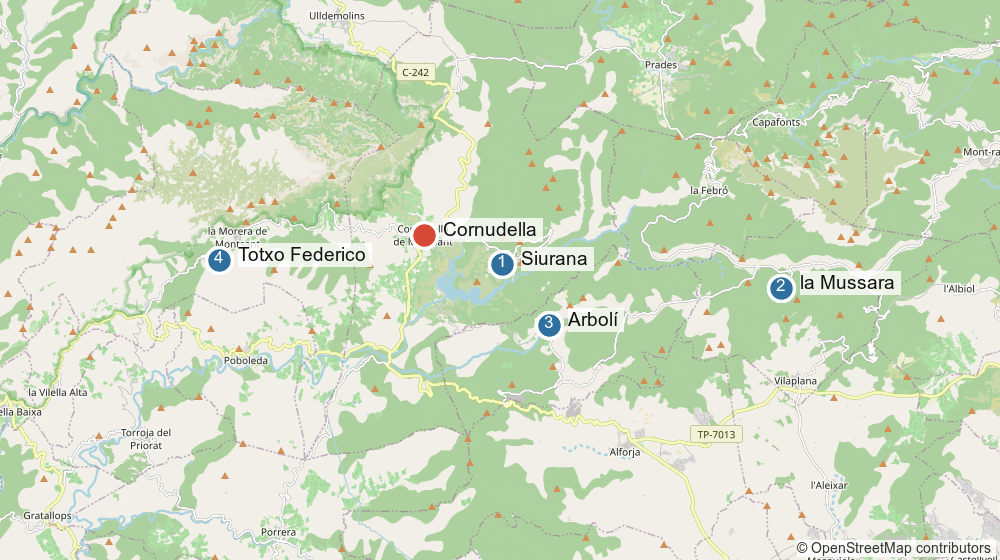
Prepping upcoming trip to Catalonia here. Four sport venues in Tarragona province — Siurana, la Mussara, Arbolí and a roadside block at Montsant — all inside a 30 minute drive of each other, climbed off one base.
Tarragona province, Catalonia
Sport, limestone + conglomerate / 4–7b
Base: Cornudella de Montsant as the base, 4–6 climbing days
Base Cornudella de Montsant (red)1 Siurana 13 min · 2 la Mussara 29 min · 3 Arbolí 18 min · 4 Totxo Federico 15 min
Planning the days
Almost everything picked here faces southeast or east, which means morning sun and afternoon shade. At Siurana that is comfortable in winter; at la Mussara, 300 m higher and wind-exposed, it means the crag goes cold well before the day ends — start early there rather than saving it for the afternoon.
The exception is Can Mansa at Arbolí, which faces south and holds sun most of the day. So it is the cold-day and late-day option, and the one to avoid once spring arrives. A sensible shape: Siurana or la Mussara in the morning, Arbolí when it is cold or when the others have gone into shade.
1. Siurana — 2–3 days
| Sector | Noted grades | Aspect | Approach | Routes |
|---|---|---|---|---|
| Can Marges de Baix | lots of V, 6a, 6b, 6c | E–SE, the shadiest of the village crags | ~5–10 min | ~12–15, 15–21 m |
| Can Marges de Dalt | V, 6a, 6b, juggy overhanging 7a+ | SE/E, morning sun | ~10 min | ~11–14, 15–27 m |
| Can Paràsit | IV–7a+ | SE, sun to midday then shade | ~10 min | ~19, 12–18 m |
The two Can Marges tiers sit directly above one another on the same approach, and Can Paràsit shares the same descent on the lower band — all three combine into one or two days. Can Marges de Baix is the better of the two tiers: steeper than the slab above it, on big jugs and good pockets, and often empty when Can Melafots is packed. Can Paràsit is the best fit for the easy end of the range — re-equipped around 2010, abrasive orange and grey rock, and one of very few Siurana crags with a real concentration of good routes at 4 to 5c.
Sector bases sit at roughly 686–716 m, just below the village at 737 m. Can Marges de Dalt is reported as badly wind-exposed — locals skip it on windy days.
2. La Mussara — 1–2 days
The sector group is Antenes, named after the TV masts above it.
| Sector | Noted grades | Aspect | Approach | Routes |
|---|---|---|---|---|
| Antenes – Espantaocells | 4, 6a, 6b, 7a | SE, sun to early/mid-afternoon | 12 min from P1 | ~20 m, 2-pitch lines to 35–40 m |
| Antenes – Follet | IV+, V, 6a, 6a+, 7a | SE (group aspect) | 15 min from P1 | up to 35 m single pitches |
Both sit on the same flat traversing path (Camí dels Cingles) from the roadside parking on the T-704, three minutes apart, so they are one walk-in and one day. Vertical, technical pocketed limestone. Follet’s 35 m pitches are long for the venue — worth a 70 m rope, or check the lower-offs on a 60.
The crag bases are at roughly 950–1000 m, so this is the venue that gets cold, windy and occasionally holds snow when Siurana and Arbolí are fine.
3. Arbolí
| Sector | Noted grades | Aspect | Approach | Routes |
|---|---|---|---|---|
| Can Mansa | IV, V, 6a, 6b, 7a | S/SE, sun most of the day | ~5 min from P3 | ~32–33, 10–15 m |
Can Mansa is a sub-sector of El Morral, and shares parking P3 with El Duc — the sector already climbed in February 2025, 1.4 km out of the village on the Coll de la Creu road towards the Pantà de Siurana. The path leaves the opposite side of the road and forks before the wall: about 22 routes left, 10 right. Short, vertical-to-slabby lines on small positive edges, described locally as cortas pero contundentes — the cruxes are compressed into 12 m, so the grades do not climb easy. Sheltered from wind, with no reliable afternoon shade.
4. Totxo Federico — short sessions
| Sector | Noted grades | Aspect | Approach | Routes |
|---|---|---|---|---|
| Totxo Federico | 4 – 7b | freestanding block — shade on one side or the other | none, roadside | — |
An enormous conglomerate block right beside the TV-7021, 1 km along from la Morera de Montsant towards Cornudella. Reachable by car with effectively no walk-in, which makes it the one to keep back for a half day, a late arrival or a spare hour — quick action when there is not much time. Spacious flat base, a small cave, a narrow rock passage with trees for shade, very quiet, and long views out over the Montsant.
Different rock from the other three: Montsant is conglomerate, so it climbs on cobbles and pockets rather than the technical limestone edges of Siurana and Arbolí. Being a detached block, there is no single aspect — follow the sun or the shade round it.
Naming is worth a check before following a sign: theCrag files this as Totxo Federico, while the local listing calls the roadside block Racó del Federico and keeps El Totxo for a different sector, 30 minutes up the Grau de Salfores path.
Access
- A new natural park is being declared over the three limestone venues. The Parc Natural de les Muntanyes de Prades, Poblet i la Serra de la Llena covers Cornudella de Montsant (Siurana), Arbolí and Vilaplana / Mont-ral (la Mussara), and its protection plan includes a climbing zoning map (Plànol O-3, ZREU Escalada). It went to public information in May 2026 and was due to start operating around the third quarter of 2026 — check the current status before booking.
Logistics
-
Flight to Barcelona (BCN) — then with a car about 1 h 45 to Cornudella. There is no useful public transport to the crags.
-
Cornudella de Montsant is the most central base: 13 min to Siurana, 15 min to Totxo Federico, 18 min to Arbolí, 29 min to la Mussara. Arbolí is the alternative if la Mussara becomes the priority (19 min there, but 30 min to Siurana). Siurana village itself is a poor base for anything but Siurana.
-
Season: main season for Siurana is October–December and March–May, with July and August too hot. February worked for Margalef and Arbolí in 2025, which transfers to Siurana and Can Mansa; la Mussara at 1000 m is the one to keep flexible.
Guidebook
- Tarragona Climbs, Pete O’Donovan and Dani Andrada
Useful Resources
- theCrag - Siurana, Antenes, Arbolí, Totxo Federico
Save this trip as a PDF — for offline use