Spain - Lleida

Prepping upcoming trip to Lleida here. The centre of gravity is Sant Llorenç de Montgai, the old school on the Segre below the Serra de Mont-roig, with the rest of the Noguera crags — Camarasa, Os de Balaguer, Santa Linya, Terradets, Àger — inside a 30 minute drive. It is a winter venue: south-facing, low, sheltered from the north wind, and the months that actually get climbed are November to April.
The two ends of the range also live in different places: the easier climbing is on the short walls and the bolted multi-pitch, while the 6c–7b volume is on the long, sustained sport walls of Xinxetes and Mordor. Both sit above the same two car parks, which makes it an easy area to climb in a pair with different comfortable grades.
La Noguera, Catalonia
Sport + bolted multi-pitch, limestone and conglomerate / ~IV+ to 8c+, most of the useful volume at 6c–7b
Base: Sant Llorenç de Montgai or Balaguer, 4–6 climbing days
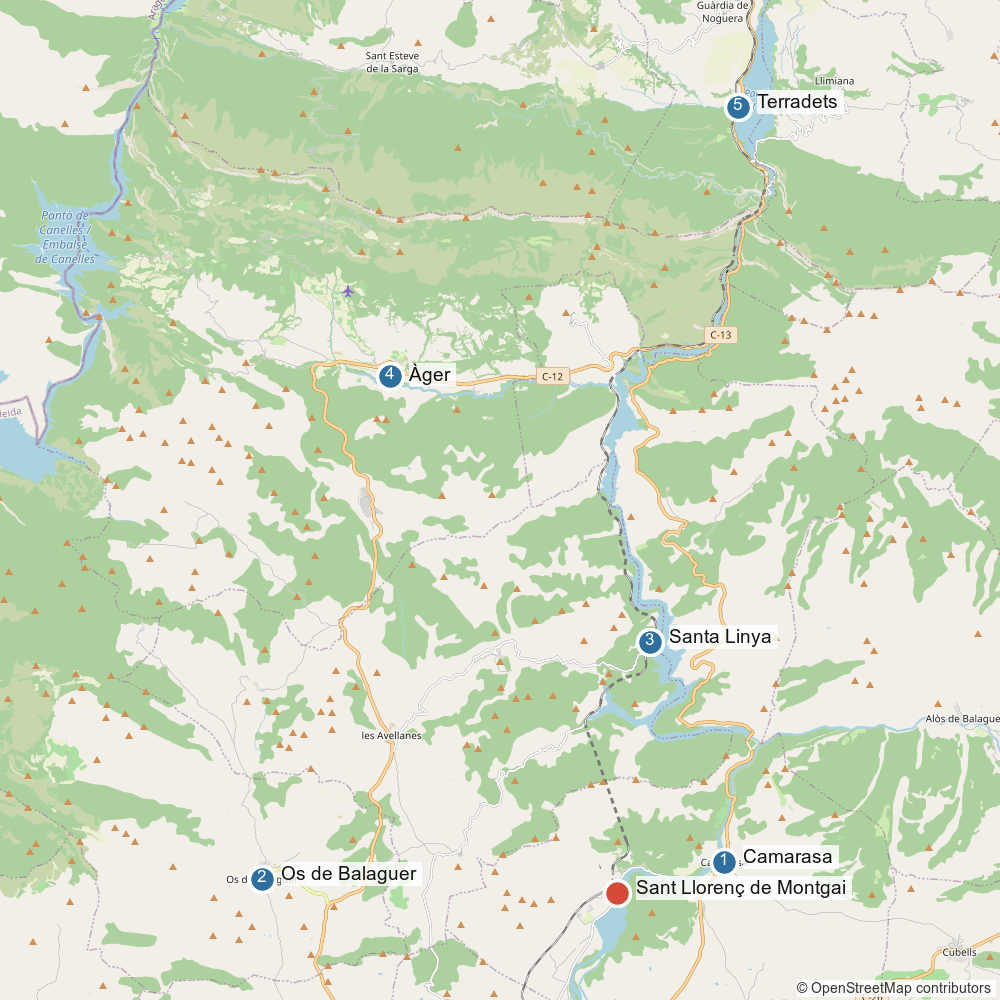
Base Sant Llorenç de Montgai (red)1 Camarasa ~10 min · 2 Os de Balaguer ~20 min · 3 Santa Linya ~15 min · 4 Àger ~30 min · 5 Terradets ~30 min
Easy — IV to V+
| Route | Sector | Grade | Notes |
|---|---|---|---|
| Variant entrada / Esperó | Sota Cilindre | V+ / V | Two short lines up a fissure and a corner, 5–15 m, 2–6 bolts |
| La del mig / La de l’esquerra | Sota Cilindre | IV+ | 12–15 m; a couple of bavaresa moves on the middle line, a pleasant slab on the left |
| Placa | Sota Cilindre | 6a | 10 m slab, the leftmost line; thinly bolted when it was put up |
| Via Normal de la Formiguera | La Formiguera | IV+ / 100 m / 3 pitches | The initiation classic of the whole area — a generation of Lleida climbers started here. Bolted belays, rappel in two or walk off (~20 min) |
| Trasparet, left-hand side | Trasparet | IV+ to 6a | East-facing, morning sun and early-afternoon shade |
| El Nen Lolillo | Font del Gat | 6a | Small, quiet, east-facing sector with a 3 minute walk-in; useful when it is hot |
Sota Cilindre is the sector to know about: the only low-grade sport wall in the valley that sits within five minutes of the car, on a southwest face above the Formiguera parking that is also the last thing here to lose the sun. Five bolted lines between IV+ and 6a. The Wednesday crew equipped most of it; before them the military used the wall for practice, and yellow marks and the odd buril are still visible.
Via Normal de la Formiguera is busy at weekends and holidays, and the wall above it holds several other easy lines that finish on the same summit. That makes it a good venue for a first multi-pitch day: short pitches, bolted belays, and a walk-off that is easier than the rappels. In 2023 a bolt was missing from the last pitch; it has since been replaced.
Moderate — 6b to 7a
| Route | Sector | Grade | Notes |
|---|---|---|---|
| Directa al Cilindre | El Cilindre | 6b (V+ obl.) / 100 m / 4 pitches | L1 6a 25 m, L2 6b 35 m (the star — pure continuity on good cobbles), L3+L4 6a 40 m. South-facing, 5 min, and one of the most repeated routes in the area; take ~22 draws if linking L3+L4 |
| Kuasto Kuesta | Paret de l’Os | 6a / 15 m | Committing climbing up the flake |
| Posturetes Orgasmatron | Paret de l’Os | 6a+ / 13 m | The left-hand route of the roadside walls |
| Nas norxes | Paret de l’Os | 6a+ / 15 m | |
| Rix rili | Paret de l’Os | 6b+ / 25 m | Sustained and technical; the best line on the roadside wall |
| La ganga | Xinxetes | 6b+ | |
| Més barat L1 / L2 | Xinxetes | 6c / 7a | A two-pitch link and a good warm-up into the sector |
| Presidiari | Disblia | 6c | |
| Rebaixes L1 | Xinxetes | 7a | The most repeated route in the sector |
| La silla electrica | Disblia | 7a | The most repeated line in the cave |
| Un quart de tres R1 | Xinxetes | 7a | |
| Sobakomesuda | Xinxetes | 7a | |
| La fi del món | Xinxetes | 7a+ | |
| Derrumba catalana | Xinxetes | 7a+ | |
| Quina tensión | Xinxetes | 7b+ | A grade above the target band, but the best-rated line in the sector on Escalibur |
Xinxetes is the volume sector: long, sustained pitches on gently overhanging conglomerate where stamina decides the grade, and a big concentration of 7a. It starts three to five minutes from the car, immediately right of El Cilindre. Mordor and Clasificado “S” continue the same wall rightwards and climb into the 7c–8a range. The wall is south-facing, but the high east face of El Cilindre starts to shade its left-hand side from mid-afternoon.
Disblia is the twin caves and the historic hard sector — powerful, bouldery, often undergraded for the number, and the one place here that can be climbed in the rain. The left-hand lines (Presidiaria 6a+, Presidiari 6c, La silla electrica 7a) are the way in.
Paret de l’Os is the roadside wall that was once the hardest crag in the province. Short, bouldery, stiff. The Neanderthal site of Roca dels Bous is in the same cliff, so the archaeology and the projects share a base.
Sectors at a glance
| Sector | Grades | Aspect | Approach | Character |
|---|---|---|---|---|
| Sota Cilindre | IV+–6a | SW | 5 min | The valley’s easy sport wall; last to lose the sun |
| La Formiguera | IV+–6a+ multi-pitch | S | 15 min | Lower-grade bolted multi-pitch; approach crosses the railway |
| El Cilindre | 6a–6b multi-pitch | S / E | 2–3 min | 90 m conglomerate wall, two and three pitch routes |
| Xinxetes / Mordor / Clasificado “S” | 6b+–8a | S | 3–5 min | Long, sustained sport; where the 7a volume is |
| Disblia | 6a+–8c+ | W caves | 10 min | Powerful twin caves; climbable in the rain |
| Paret de l’Os | 6a–8c+ | S | 1 min | Historic hard roadside wall, short and bouldery |
| Trasparet | IV+–6a left, harder right | E | 5 min | Easy on the left, bouldery on the right |
| Font del Gat | 6a and up | E | 3 min | Small, quiet, good in the heat |
| Esperó Remacha | multi-pitch | S | 1 min | Pinnacle with several good multi-pitch routes |
| Kurtika | steep, hard | E | 1 min | Spectacular overhanging lines |
| El Balcó de Sant Llorenç | very steep, projects | SE | 10 min | Recently equipped; afternoon shade |
Shape of the trip
A sensible first day is Sota Cilindre in the morning and the Directa al Cilindre in the afternoon, both within five minutes of the Formiguera parking and both south-facing. Then a Xinxetes day for the long sport pitches and a Formiguera Normal day for the easier multi-pitch, and swap between the two. Keep Disblia back for a wet or cold day, and Paret de l’Os for a half day, since the routes there are short.
Access
- From Balaguer take the C-13 towards Camarasa; a little before Camarasa the LV-9047 turns left and runs straight into Sant Llorenç de Montgai. The crags are the cliffs above the village and El Cilindre is visible from the road bridge.
- P1 — 400 m northeast of the village, a lay-by on the reservoir side of the road, or the larger area opposite at the entrance to the Barranquet del Mas del Cinto. Serves La Formiguera, El Balcó, Disblia, Agulla de l’Isard, El Cilindre and Xinxetes / Mordor.
- P2 — roadside 1 km east of the village, below the pinnacle. Serves Esperó Remacha and Paret de l’Os; about a minute’s walk-in.
- P3 — lay-by at the Pont d’Escalera road bridge, for Kurtika. P4 — 600 m southeast of the bridge, for Font del Gat and Trasparet.
- The La Formiguera approach crosses the railway line near a tunnel entrance. Cross with care; there is an alternative path on the right that stays below the line.
Season
- November to April, with November and February the busiest months on the logbooks. South-facing and sheltered from the north wind by the Mont-roig, so it is a genuine winter crag rather than a shoulder-season one.
- Summer is very hot. The exceptions are the west-facing caves of Disblia, shaded until mid-afternoon, and evening ascents on the east-facing walls of El Cilindre.
- Fog can sit in the valley in December and early January.
Logistics
- Base: Sant Llorenç de Montgai itself, with Camping La Noguera on the south side, if the trip is all about the crag; Balaguer (9 km, supermarkets, more beds) if a town base is preferred.
- A car is essential. The village has a halt on the Lleida–La Pobla de Segur line, which is fine for arriving but not for getting to the crags.
- Wear helmets. The conglomerate bands are not always solid, holds do come off on the newer sectors, and belayers are as exposed as leaders.
- Old-school grades: on Paret de l’Os and Disblia the numbers are widely reported as stiff and undergraded.
- Railway: the La Formiguera walk-in crosses a live line; the crossing is at a tunnel mouth with limited sightlines.
If a second area is wanted
- Camarasa — 10 min. The other half of the old Lleida school, same limestone and conglomerate mix, more moderate sport.
- Terradets — 30 min. Big limestone multi-pitch, e.g. the Diedre Audoubert on the Paret de Catalunya (400 m, 6b+).
- Santa Linya — 15 min. World-class hard sport, 9a and up. Worth a look, but not a crag to plan the trip around.
- Àger — 30 min. Sport and a via ferrata, another weather option.
Guidebook
- Lleida Climbs, Pete O’Donovan and Dani Andrada — covers Sant Llorenç, Camarasa, Terradets and Santa Linya.
- The Topo premium topo for Sant Llorenç de Montgai (Podclimbing) — sectors, approaches and photos, and the most current source for the newer walls.
- Escaladas en La Noguera, Joan Escuer and Jordi Marmolejo (PRAMES, 1997) — the historic guide to Camarasa, Sant Llorenç and Mont-roig, available as a free PDF. The old piades books are kept at the bar El Mirador del Llac in the village.
Useful Resources
- theCrag — Sant Llorenç de Montgai
- Escalibur — route list and grade distribution
- Mountain Project — area page
- Climbapedia — crag notes and a partial route list
Save this trip as a PDF — for offline use